|
DECADE
VOLCANO PROGRAM - IAVCEI - IDNDR
|
|
|
|
|
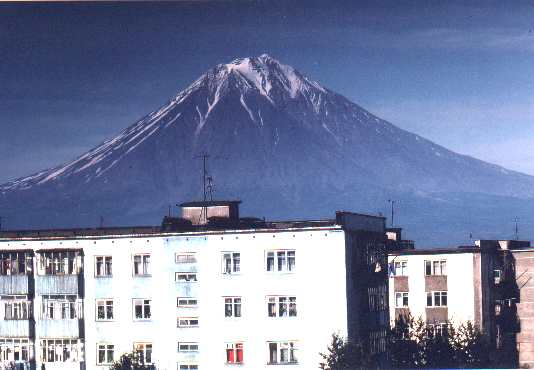
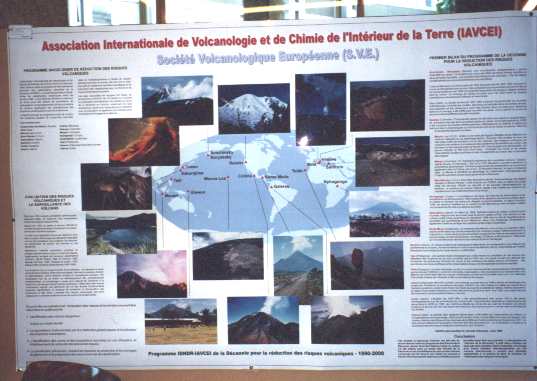
IAVCEI'S PRINCIPAL IDNDR PROJECT, DECADE VOLCANOES As the end of the International Decade for Natural Disaster Reduction (IDNDR) draws near, we take stock of progress. Sixteen Decade Volcanoes have been a focus of concerted research and outreach work during the IDNDR. Projects at each volcano involve intensive, international, interdisciplinary work to improve and demonstrate tools for volcanic disaster prevention -- intensive, to address urgent problems before another volcanic disaster can occur; international, to introduce new tools and thought paradigms, complementing those of the local scientific team; and interdisciplinary, to achieve the exciting synergism that results when colleagues with varied expertise work together on a common problem. Here is a small selection of the accomplishments of Decade Volcano projects, to illustrate a range of scientific studies and mitigation efforts. Avachinsky-Koryaksky: Stratigraphic reconstruction revealed at least 112 eruptions of the past 8000 y, in two stages of activity. The volumes and column heights (~mass discharge rates) were estimated for the larger events. Colima: Eruption crises of 1991 and of 1998-1999 (continuing) were successfully managed. Larger-than-normal explosions in May 1999 required evacuation of several villages near the foot of the volcano. Exchange visits are planned in 2000 A.D. for teams from "twin" volcanoes Colima and Merapi. Etna: The lava flow of 1991-1993 challenged authorities to find new methods for lava control. Blocks were dropped into a lava tube; explosives were used to breach the tube and divert lava;and a dam was built to pond lava. The last, at least, helped to save the town of Zafferana. Galeras: Important lessons were learned about buildup of gas pressures in the near-surface. A special issue of Jour. Volcanology and Geothermal Research, "Galeras Volcano, Colombia: interdisciplinary study of a Decade Volcano" was dedicated to the memory of six volcanologists who were killed in January 1993. Mauna Loa: Detailed geologic mapping and radiocarbon and paleomagnetic dating of >180 lava flows allowed estimates of recurrence intervals; chemical analyses yielded details of magma plumbing and resupply. Data are being compiled in GIS format. Also, submersible studies of Mauna Loa's SW rift zone reveal abundant picritic flows and changes in magma source components. Merapi: Major collaborative program between Volcanological Survey of Indonesia and German GFZ, particularly strong in geophysical monitoring. Some collaborative work continues also with France, U.S., New Zealand, Japan, and other countries. Merapi may have more international collaboration than any other Decade Volcano. Mount Rainier: An educational video, "Perilous Beauty - The Hidden Dangers of Mount Rainier," was produced by USGS. Also, as part of a compromise between public safety officials and real-estate developers, an acoustic early warning system was developed for collapse events and lahars. Nyiragongo: Seismic, tilt, EDM, and thermal monitoring were increased in 1994, when the lava lake began to rise and threaten refugees from nearby Rwanda. Beginning in October 1996, escalating civil strife destroyed all stations and halted monitoring. Sakurajima: Beginning in 1994, Sakurajima eruptions declined and unerupted new magma was stored beneath nearby Aira caldera. An Asian Active Volcano Summit was held in November 1998, in Kagoshima City, for sharing of experiences during volcanic crises among local officials and scientists from Japan, Philippines, Indonesia, and Italy. Santa Maria: A well-attended workshop in November 1993 generated much enthusiasm and many plans. Regrettably, support from higher levels of the government was not forthcoming, and disappointingly few of the plans have been implemented. One village, El Parmar, was evacuated in 1998 before it was destroyed by lahars associated with the Santiaguito dome. Santorini: A modern network of telemetered seismometers, tide gauges (to detect uplift), thermometers, and CO2-flux instruments was established, as was a non-profit organization, the Institute for the Study and Monitoring of Santorini Volcano (ISMOSAV). Taal: A broad stratigraphic framework was established, complemented by more detailed studies of ~5ka BP eruptions. Current work is examining sequence of activity within single eruptions, and notable variation from proximal to distal facies. Workshops for scientists and local leaders. Teide: Teide became the site for a Post-Graduate International Course on Volcanology, sponsored by UNESCO, IAVCEI, and other organizations. Procedures for preparing and releasing volcanic hazards information were formalized in law. GIS methods were used to assess and portray hazards and risks. Ulawun: A 1998 workshop developed plans for improved seismic monitoring, a hazard map that reflects common Ulawun activity, and study of the stability of the Ulawun edifice. Unfortunately, a massive civil service cutback in Papua New Guinea in April-May 1999 will require that activities be scaled back or delayed. Unzen: Unzen's eruption from 1990-1995 was exceptionally well documented, and many scientific lessons have been published (for example, special issue of Jour. Volcanology and Geothermal Research, 1999). Also, debate about whether the eruption had ended led to a useful set of criteria for this purpose -- some of which were later applied to Montserrat. Vesuvius: The first modern evacuation plan for Vesuvius was introduced by Osservatorio Vesuviano, Gruppo Nazionale per La Vulcanologia (GNV) and Protezione Civile. It defines hazard zones, scientific alert levels and civil defense responses, referenced to the 1631 eruption. The plan calls for evacuation of ~600,000 people in 1-2 weeks, if the march of precursors toward an eruption is judged irreversible. These and many more projects have been undertaken at Decade Volcanoes. No UN or other funding was obtained for the Decade Volcanoes project as a whole, so scientists at individual volcanoes were left to arrange funding for work as best as they could, from national and bilateral sources. Designation of volcanoes as Decade Volcanoes probably helped in some cases, but not in others. Overall, the concept of focused international, interdisciplinary work at selected volcanoes produced substantial dividends of science and volcanic risk mitigation. Scientists who were able to raise funding for new work, and those who were able to accomplish much even without new funding, deserve hearty congratulations and encouragement to continue their good work. These and other volcanoes will surely not stop erupting at the end of the Decade, nor even at the end of the millennium! IAVCEI, sub-commission for decade volcano - June 1999 *********************************************************************************************************************************** RECENT IAVCEI MEETING CITIES ON VOLCANOES 6 – Tenerife May 31st - June 4th, 2010 Final report by Nemesio M. Pérez – ITER - SPAIN The sixth edition of the largest international conference on volcanic risk management “Cities on Volcanoes” was recently held at Puerto de la Cruz (Tenerife, Canary Islands, Spain) from May 31 to June 4, 2010. CoV6-Tenerife 2010 was organized by Fundación Canaria ITER and the Cabildo Insular de Tenerife and co-hosted by the Comission of Cities and Volcanoes (CaV) of the International Association of Volcanology and Chemistry of the Earth's Interior (IAVCEI) as well as several international (International Society of Rock Mechanics, ISRM), national (Spanish Volcanological Society, SVE; Spanish Society of Rock Mechanics, SEMR), regional (Canarian Association of Volcanology, AVCAN) and local (The City of Puerto de la Cruz, Instituto Tecnológico y de Energías Renovables, ITER) organizations and institutions. The aim of the conference was to bring together geoscientists working on active volcanoes, authorities, civil protection specialists, city planners, social scientists, economists, psychologists, educators, health specialists, engineers, mass media and general members of communities living in active volcanoes to exchange and understand their experiences and knowledge in order to evaluate and improve prevention/mitigation actions, land-use planning, emergency management, and all required measurements to improve volcanic risk management in densely populated volcanic regions. CoV6-Tenerife 2010's Open Ceremony was chaired by Ricardo Melchior (President of the Cabildo Insular de Tenerife), Domingo Berriel (Minister for the Environment and Land Planning of the Government of Canary Islands), Marcos Brito (Mayor of the City of Puerto de la Cruz), Setsuya Nakada (President of the IAVCEI), and Luis Lamas (Secretary General of the ISRM). One major issue to highlight from the Open Ceremony was the announcement made by Ricardo Melchior of the launch of the Canarian Volcanological Institute (Instituto Volcanológico de Canarias, IVC) in June 2010 following the unanimous decision of the Spanish Senate in 2005 to improve and optimize the management of volcanic risk in Spain. Tenerife, an active volcanic and densely populated island with a low volcanic risk perception among its inhabitants, was a marvellous place to run this open scientific and technical discussion on volcanic risk management. In addition, CoV6-Tenerife 2010 was also an ideal forum to discuss about the plus side of living in active volcanoes since the short-term hazards posed by volcanoes are strongly balanced by benefits of volcanism over geologic time. Therefore, CoV6-Tenerife 2010 scientific and technical sessions were organized into 4 major symposiums: The science of volcanoes (symposium 1); How to live with volcanoes: the risks (symposium 2); How to live with volcanoes: the opportunities (symposium 3); Recent eruptions since CoV5-Shimabara 2007, and volcanic crisis management in special settings (symposium 4). CoV6-Tenerife 2010 was in general a successful meeting which received 653 contributions (17 plenary talks, 238 oral and 398 poster presentations) and ~ 500 drawing and models of volcanoes made by primary and high school students from Tenerife. The CoV6 abstract volume and the meeting programme can be actually downloaded from the CoV6 web page (www.citiesonvolcanoes6.com). A total number of 863 participants from 53 different countries (Argentina, Australia, Belgium, Bolivia, Brasil, Cameroon, Cape Verde, Colombia, Comores, Costa Rica, Cuba, Chile, China, Dominican Republic, Ecuador, El Salvador, France, Germany, Guatemala, Hungary, Iceland, Indonesia, Iran, Ireland, Italy, Japan, Kenya, Luxembourg, Mexico, Monserrat, New Zeland, Nicaragua, Nigeria, Norway, Papua New Guinea, Peru, Philippines, Portugal, Puerto Rico, Russia, Rwanda, Saudi Arabia, Singapore, Spain, Switzerland, Taiwan, Tanzania, The Netherlands, Tunisia, Turkey, U.K., U.S.A., and Venezuela) were registered for CoV6-Tenerife 2010. Several pre-, intra-, post- conference field trip and activities were also conducted at CoV6. Taking into account that Tenerife is yearly visited by 4-5 million tourists, a workshop on volcanoes, volcanic risk management and tourism was organized for the local tourist professional sector by the CoV6 organization prior to the conference as well as a workshop on volcanoes, volcanic risk management and communication for journalists. Beside these activities two field trips were also conducted prior to the conference. “Management and exploitation of groundwaterresources in an active volcanic island: the case of Tenerife” lead by Juan J. Coello and Ricardo Bacells (both at the Water Resources Department of Tenerife Island), and “Gravitational landslides in the volcanic island of Tenerife” lead by Luis González de Vallejo (Univ. Complutense de Madrid) and Mercedes Ferrer (Spanish Geological Survey, IGME). A total number of 50 participants were registered for these pre-conference field trip and activities. Beside the CoV6 scientific and technical sessions, several specific workshop and discussion forums were addressed during the conference (i) Forum on “Assessment of volcanic ash threat: learning and considerations from the 2010 Eyjafjallajökull eruption” by Arnau Folch (Barcelona Supercomputer Center), (ii) Forum on “Volcanic landslides” lead by Luis González de Vallejo (Univ. Complutense de Madrid) and Mercedes Ferrer (Spanish Geological Survey, IGME), (iii) Forum on “Outreach” lead by Carolyn Driedger (USGS), and (iv) the UNESCO Workshop “International mobile early-warning system(s) for volcanic eruptions and seismic activities (IMEWS)” lead by Kristine Tovmasyan (UNESCO) and Roberto Scarpa (University of Salerno, Italy). In addition to these activities a specific programme for the general public and local population entitled "Volcanes de Película" was carried out by the CoV6 Organization at the local Cinema in Puerto de la Cruz. The objective of this programme was to contribute to greater public awareness about the meaning of livingwith volcanoes.During the conference this program showed several movies and documentals related to volcanoes, and volcanic activity such us “Understanding Volcanic Hazards”, “Reducing Volcanic Risk”, “Pompeii: The Last Day”, “Mararia”, “Dantes Peak”, “Eruptions at the sea (Reunion)”, “Living with Usu Volcano”, “Monserrat Andesite Volcano”, “Chinyero: 100 years of silence”, “When time Ran Out”, and “Supervolcano”. A total number of 1704 participants did attend this volcano movie programme. From May 31 to June 4 several intra-meeting field trip and activities were organized by CoV6 : Volcano field trips were conducted in all the islands with historical volcanism (Lanzarote, Tenerife and La Palma). Cumbre Vieja field trip (La Palma) was lead by Simon Day (Univ. College, London) and Eleazar Padrón (ITER) while Timanfaya (Lanzarote) field trip was lead by Carmen Romero (Univ. of La Laguna). In the case of Tenerife the field trips to Las Cañadas caldera and the summit cone of Teide volcano were lead by José A. Rodríguez Losada (Univ. of La Laguna), Rodrigo del Potro (Univ. Bristol), Pedro A. Hernández (ITER) and David Calvo (ITER). Other intra-meeting activities at Tenerife were the Visit to Civil Protection Coordination Center (1-1-2) at Tenerife Island and the Cultural trip about volcanoes & wine at Tenerife. After June 4, 2010, “Tenerife's explosive volcanism field trip”lead by Ray Cas (Monash Univ., Australia) and Adrian Pittari (The University of Waikato, New Zeland), and the “Ash Fall Impacts Working Group Workshop" lead by Kristi Wallace (USGS/Alaska Volcano Observatory, USA), Graham Leonard (GNS Science, New Zeland), and Tom Wilson (University of Canterbury, New Zeland) were the post- activities offered in the CoV6 framework. A total number of 70 participants were registered for these post-conference field trip and activities. CoV6-Tenerife 2010's Closing Ceremony was chaired by Ricardo Melchior (President of the Cabildo Insular de Tenerife), Carlos Alonso (Vicepresident of the Fundación Canaria ITER), José Ignacio Peralta Sánchez (The Mayor of the City of Colima) and Graham Leonard (Secretary of the Comission of Cities and Volcanoes of the IAVCEI). Three major issues can be highlighted from this Closing Ceremony. One of them was the announcement of a new association, the World Organization of Volcano Cities (WOVOCI), following a proposal from the Cabildo Insular de Tenerife. This new association is a marvellous initiative and will be tremendously beneficial to enhance strategies which can help to improve community awareness about volcanoes and promote volcano cities transnational cooperation on volcanic risk management with the collaboration of the Comission of Cities and Volcanoes of the International Association of Volcanology and Chemistry of the Earth's Interior (IAVCEI). The WOVOCI's main objective is the application of scientific research and knowledge to enhance the civil protection as a public policy. The WOVOCI founded members (the cities of Colima, Mexico; Kagoshima and Shimabara, Japan; Fuencaliente and Puerto de la Cruz; Spain and the Cabildo Insular de Tenerife; Spain) will do the best to involve most cities on volcanoes all over the world into the WOVOCI to promote future CoV conferences as well as other IAVCEI meetings. Another issue to highlight was the reading by Steve McNutt of a letter of support for the Canarian Volcanological Institute (IVC), which was written and signed by Hans-Ulrich Schmincke (Germany), Setsuya Nakada (Japan), Steve McNutt (USA), Chris Newhall (Singapore), Kenji Notsu (Japan), Franco Barberi (Italy) and Hiroshi Wakita (Japan) “The establishment of the Canarian Volcanological Institute (Instituto Volcanológico de Canarias, IVC) as a joint effort of different enhance collaborative scientific efforts and to help reduce volcanic risk in the Canary Islands. We, the undersigned, strongly endorse the unanimous declaration of the Spanish Senate made on November 2, 2005, and urge the setting up of the Canarian Volcanological Institute. We support the recent public announcement by Ricardo Melchior, President of the Cabildo Insular de Tenerife, made at the Open Ceremony of the International Conference Cities on Volcanoes 6 – Tenerife 2010.” Finally, the third issue to highlight was the announcement mabe by Graham Leonard (Comission of Cities and Volcanoes) about the next CoV meeting which will take place at Colima (Mexico) from November 19 to 23, 2012 (Cities on Volcanoes 7 – Colima 2012). During this Closing Ceremony , the Mayor of the City of Colima, José Ignacio Peralta Sánchez, did provide a 5 minutes talk about the City of Colima and Colima volcano inviting us to meet at Colima for the Cities on Volcanoes 7 – Colima 2012. From : IAVCEI News 2, Cities and volcanoes commission Contact : Henry Gaudru, UNISDR scientific advisor for volcanic risk mitigation - Cities in Volcanoes Commission |